
Step 1. Pick the one person you want to reach
Not "entrepreneurs" or "people who want to grow". A real description, like "founders of B2B software companies doing $1M to $10M a year who sell to enterprise". The narrower it is, the easier every later decision gets, from topics to titles to which platform you use.
If you already have clients, look at your best three. What do they have in common? Start there.
Step 2. Write your position in one sentence
Use this format: I help [who] get [result] through [how]. For example, "I help private clinics fill their calendar through doctor led content." It doesn't need to be clever. It needs to be clear enough that a stranger could repeat it back to you.
Every piece of content should connect back to this sentence somehow. If an idea doesn't, skip it.
Step 3. Fix your profiles before you post
People will check your profile the first time a video does well. Make sure it's ready for them.
- A name and headline that say what you do, not just your job title.
- A photo where your face is clear.
- A bio that repeats your one sentence position.
- One link, to a page where someone can take the next step: a booking page, an application or a free resource.
- On YouTube, a banner that says who the channel is for and when you post.
Step 4. Choose three content topics
These are usually called content pillars. Pick three topics you could talk about for years without running out. For most founders they look something like this:
- What you know: how your field actually works, explained simply.
- What you've seen: client stories, mistakes, before and after.
- What you think: your opinions on where your industry is going.
Write 10 video ideas under each. If you can't get to 10 for a topic, it's probably the wrong topic.
Step 5. Pick one main platform
YouTube if your buyers research before they buy. Instagram or TikTok for consumers and quicker reach. LinkedIn for B2B. Our personal branding guide goes through this choice in more detail.
Choose one main platform plus one secondary one where you repost shorter cuts. That's enough for the first six months.
Step 6. Record in batches, once a month
The founders who keep going are the ones who don't have to think about content every day. Block one recording day a month, or even just a few hours, and record four long videos or 15 to 20 short ones in that session.
Milan Savov, founder of SmartClick, gives us about 60 minutes a month. From that, his Instagram went from zero to 228K views. Scripting, editing and publishing happen without him. See his case study.
Step 7. Script the first ten seconds of every video
You don't have to read a full script if you don't like it. You do need the opening written down. The first sentence should say who the video is for or what problem it solves. "If you run a clinic and your calendar isn't full, this is probably why" works much better than "Hey guys, welcome back".
Write the rest as bullet points in the order you'll say them, then record each section a couple of times.
Step 8. Publish on a fixed schedule for at least six months
A realistic minimum is one long video a week, or three to five short videos a week on your main platform. Pick your days and keep them.
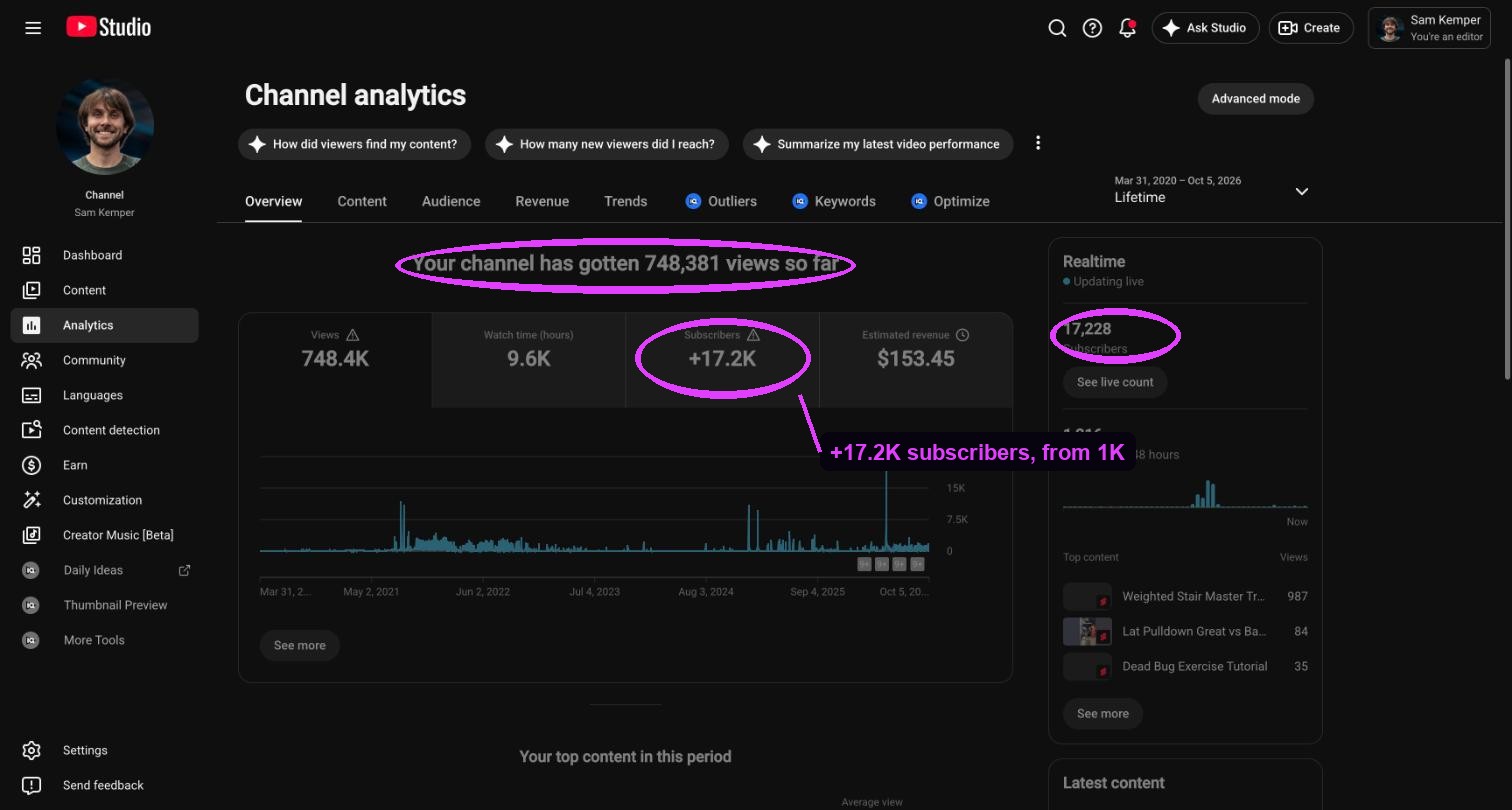
Expect the first two or three months to feel slow. Sam Kemper's YouTube had about 1K subscribers and 17 videos when he started with us. He had 17.2K subscribers by video 173.
Step 9. Give every viewer one next step
A personal brand that doesn't lead anywhere is a hobby. Decide what you want a viewer to do: book a call, apply, download something or join a list. Mention it at the end of long videos, pin it in your comments and keep it in your bio.
Keep it to one thing. Three different calls to action usually means nobody does any of them.
Step 10. Track conversations, not followers
Followers are useful, but they don't pay you. Once a month, look at four numbers: views on your main platform, profile visits, link clicks and conversations started (messages, calls booked, applications). If views go up and conversations don't, the problem is your profile or your offer, not the content.
A simple 90 day plan
- Days 1 to 14: steps 1 to 4. Position, profiles, three topics, 30 ideas.
- Days 15 to 30: first recording day. Edit and schedule the first month.
- Days 31 to 60: publish on schedule. Second recording day. Check which videos people watched to the end.
- Days 61 to 90: third recording day, with more of the topics that worked. Add your secondary platform.
When it makes sense to get help
If you've been posting for a few months and nothing is moving, or you already know you won't keep it up alone, that's when a team makes sense. We run all of this for founders as one system. You can see how on our personal branding agency page.
Questions people ask
How long does it take to build a personal brand?
Expect early signals in 60 to 90 days and meaningful results after 6 to 12 months of consistent posting.
Can I build a personal brand without showing my face?
You can build an audience without your face, but a personal brand is about trust in a person. Most founders who start faceless end up adding their face later.
What if I'm not good on camera?
Almost nobody is at the start. A scripted opening, short sections and a second take fix most of it. By the third recording session most founders are fine.
Do I need expensive equipment?
No. A recent phone, a clip on microphone and a window for light is enough to start. Upgrade once you've proven to yourself that you'll keep posting.