
What personal branding means when you run a company
Most definitions talk about "your reputation" or "how you show up". That's true, but it doesn't help much when you have a business to run. Here's the version we use with clients.
Your personal brand is the answer to three questions a stranger asks after hearing your name. Who is this person? Do they know what they're talking about? Should I trust them with my money or my problem?
If they search you and find nothing, or a LinkedIn profile you haven't touched in years, they answer those questions with a guess. If they find 40 videos where you explain your field clearly, they've answered them before you even speak. That's really all it is.
Why it matters more now than five years ago
A few things changed at the same time.
- Buyers research on their own first. In most B2B and high ticket deals, the prospect has watched you, read you or asked someone about you long before the first call. A founder with no content loses deals they never hear about.
- Ads got more expensive and less trusted. A person explaining something useful still gets attention for free. A logo with an offer mostly doesn't.
- AI search is now part of the research. People ask ChatGPT, Claude or Google's AI answers "who is the best person for this". Those answers are built from what's been published about you and your company. If nothing is published, you're not in the answer.
Personal brand vs company brand
A company brand is the logo, the website and the product. A personal brand is a person. People follow people much more easily than companies, which is why a founder's account often outgrows the company account within a year.
You don't have to choose. In practice the founder's content brings the attention, and the company website is where people go to check details and buy. For most of our clients the founder is the top of the funnel and the company is the bottom.
Dr. Shaan is a good example. He's a physician at Royal Wharf Clinic in London, and his own Instagram went from 21K to 262K followers. The clinic benefits from that, but the audience follows him. You can see the before and after on his case study.
The six parts of a founder's personal brand
When we audit someone, we look at six things. The weak spot is almost always in one or two of them, not all six.
- Positioning. One sentence that says who you help and with what. If you can't say it, your content won't either.
- Content engine. How ideas turn into scripts, recordings and finished videos every week without eating your calendar.
- Distribution. Which platforms, how often, in which format. Long form on YouTube, short form on Instagram and TikTok, text and video on LinkedIn.
- Profile stack. Your bios, banners, featured links and pinned posts. This is where a curious viewer decides to take the next step or leave.
- Lead engine. The path from viewer to conversation: a call to action, a lead magnet, an application or a booking page.
- Growth loop. What you measure each month and what you change because of it.
Which platform should a founder start on?
Start with one main platform and one secondary one. Spreading across five on day one is how most founders burn out by the second month.
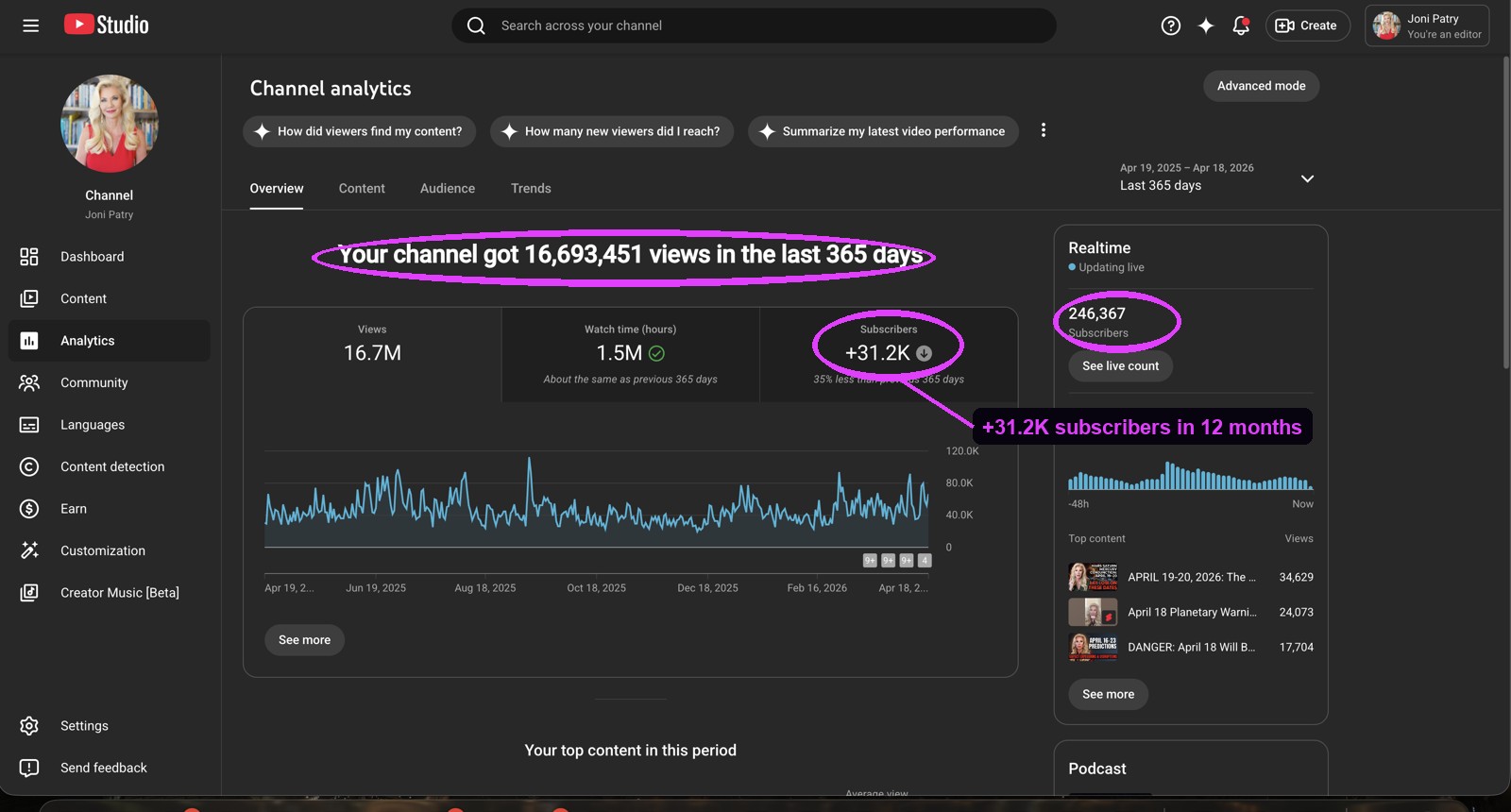
- YouTube long form if your buyer researches before buying: finance, health, law, consulting, B2B services. A good video keeps getting found for years. Joni Patry's channel did 16.7M views in the 365 days to April 2026, and a lot of that came from older videos that keep ranking.
- Instagram reels or TikTok if you sell to consumers or need reach quickly. Volume matters here. Miguel Girones published 781 reels in twelve months, they drew 38.5M plays, and his Instagram went from 25K to 326K followers.
- LinkedIn if you sell B2B and your buyers spend time there. Text posts plus short native video. Dylan Kinder (DataCose) and Chris Dufey (Rainmakers) built theirs mostly on LinkedIn.
Most founders end up running long and short form from the same recording day. One good hour on camera can be cut into a long video and several shorts.
How long does it take?
Honest answer: the first signals usually show up in 60 to 90 days, and the real results come after 6 to 12 months of publishing consistently. Anyone promising a big personal brand in 30 days is selling something else.
Two reference points from our own clients:
- Sam Kemper, a fitness coach in Sydney, had about 1K YouTube subscribers and 17 videos when we started. At 173 videos he had 17.2K subscribers and 748K lifetime views (YouTube Studio, 6 October 2026). Case study.
- Milan Savov, founder of the SEO agency SmartClick, started in September 2025 with zero audience. With about 60 minutes of his time a month, his Instagram reached 228K views and his YouTube 27.2K views, all organic. Case study.
The pattern is similar in both. Not much happens for the first stretch, then one or two videos break out and people start watching the rest of the library too.
What it costs
There are three ways to do it, and you pay either in time or in money.
- Do it yourself. Free in cash, expensive in time. In our experience it's 8 to 15 hours a week once you count scripting, recording, editing and posting.
- Hire freelancers. An editor, maybe a scriptwriter. You'll pay less than an agency, but you become the project manager and the strategist.
- Hire a personal branding agency. Strategy, scripts, editing, publishing and inbound handled as one system. Ours starts from $2,000 a month. More on that on our agency page.
Mistakes we see most often
- Posting without a position. General motivational content builds an audience that never buys anything.
- Chasing views instead of the right viewers. 10,000 views from the wrong people are worth less than 500 from buyers.
- Quitting in month two. Most channels look dead right before they start working.
- Nothing to click. The video does its job and then the profile has no next step.
- Hiding the founder. Faceless brand content can get reach, but trust goes to people.
If you're starting from nothing, the next guide is how to build a personal brand from zero. If you're already posting and it's not moving, read how to grow your personal brand.
Questions people ask
What is personal branding?
Personal branding is what people find, see and believe about you when they look you up, and the content you publish to shape that. For founders it's mainly a way to build trust with buyers before the first sales conversation.
Is personal branding only for influencers?
No. Most of the people we work with are founders, doctors, consultants and coaches who don't want to be influencers. They want the right buyers to know who they are before the first call.
Do I need to be on camera?
For a personal brand, yes, at least some of the time. You don't need to be a natural. Good scripts and a short recording day do most of the work, and most people get comfortable within two or three sessions.
How often should I post?
A minimum that works: one long video a week, or three to five short videos a week on your main platform. Keeping it up for months matters more than how much you post in any one week.
Can a personal brand help me show up in ChatGPT and Google?
Yes. Videos, transcripts, articles, interviews and profiles with your name and expertise are what search engines and AI assistants read when someone asks about your field.