
First, find where it's stuck
Growth problems all look the same from the outside ("it's not growing"), but they have different causes. Look at your last 20 posts and see which of these fits.
Nobody sees it
Low views across the board. This is almost always the first three seconds, the title and thumbnail, or not posting enough. The content itself might be fine.
People see it but don't follow
Decent views, few new followers. Usually the videos are useful but don't make it clear who you are or why someone should come back. Every video should make it obvious what you talk about.
People follow but don't buy
The audience is growing and there are no enquiries. That's a profile and offer problem. There's no clear next step, or the next step asks for too much too early.
Fix the packaging before making more content
On YouTube, the title and thumbnail decide whether anyone watches. On Instagram, TikTok and LinkedIn, it's the first line and the first second. We rewrite these before touching anything else, because a good video with a weak opening gets the same result as a bad video.
- Say who it's for in the first sentence.
- Open with the problem or the result, not an introduction.
- On YouTube, make the title something your buyer would actually search for or click on.
Joni Patry's channel did 16.7M views in the 365 days to April 2026. In one 28 day window in that period it got 12.6M impressions at a 6.3% click rate. See the Studio captures.
Post more without recording more
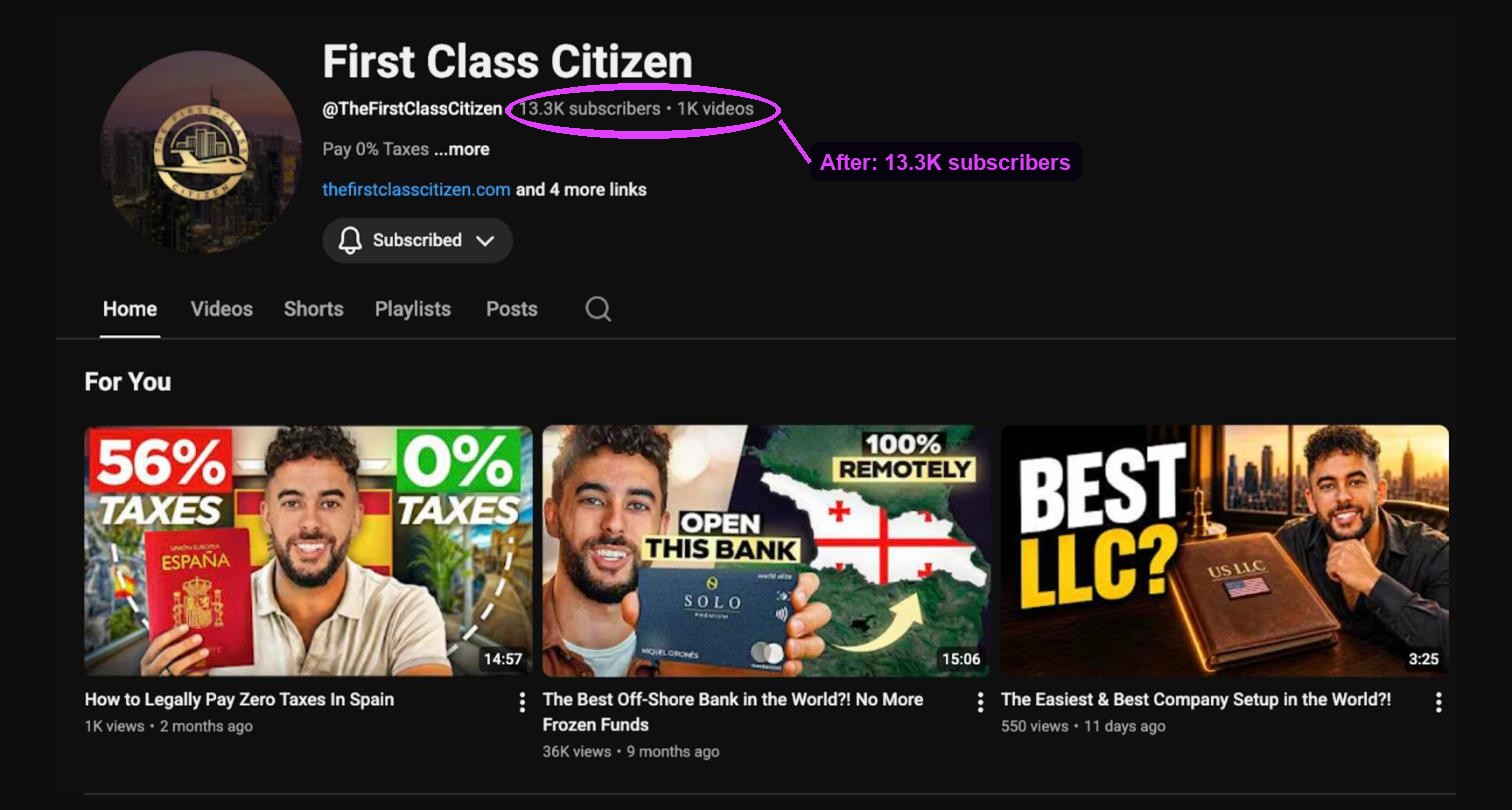
On short form platforms, growth is partly a volume game. Miguel Girones published 781 reels in twelve months. They drew 38.5M plays and his Instagram went from 25K to 326K followers.
A practical way to get volume: record one long video or conversation a week, then cut it into five to ten shorts, a LinkedIn post and an email. One recording gives you a week of content.
Platform by platform
YouTube
Pick topics people search for, not only topics you like. Make videos long enough to answer the question properly, and post on a fixed day. Watch average view duration and click rate, and rework the title and thumbnail on videos that get impressions but no clicks.
Reels are for reach, carousels and stories are for trust. Post reels at least three to five times a week. Use your bio and pinned posts to explain who you help, because that's where new viewers decide whether to follow.
Post from your personal profile, not just the company page. Short text posts with a clear opinion and native video both work well. Comment on posts from people your buyers already follow. Chris Dufey runs LinkedIn and Instagram for his coaching company Rainmakers. Case study.
TikTok
Similar to reels, with faster feedback. It's a good place to test hooks. If an opening works on TikTok, it usually works on reels too. Mafe Anzures grew from 321K to 612K TikTok followers organically. Case study.
Borrow other people's audiences
The biggest jumps usually come from someone else's audience. Go on podcasts in your field, collaborate with people who serve the same buyer, and get featured in industry newsletters. Every appearance also puts your name in more places online, which helps you show up in Google and in AI answers.
Turn the audience into clients
If you're growing and still not getting enquiries:
- Make your bio say who you help and with what, in one line.
- Use the same call to action everywhere.
- Put proof on your profile: a case study, client results, a screenshot.
- Make some content for people who are close to buying: how you work, what it costs, what results look like.
Most founders only make content for people who've never heard of them. A few videos aimed at people who already know you can do more for revenue than another viral clip.
What to measure each month
Views and followers tell you about reach. Profile visits and link clicks tell you about interest. Calls booked and applications tell you about money. Check all three once a month and change one thing at a time, so you know what worked.
Questions people ask
Why is my personal brand not growing?
Usually one of three things: weak openings and packaging, posting too little, or an unclear topic. Check views first, then how many viewers follow, then enquiries, to see which one it is.
How many times a week should I post to grow?
On short form, three to five times a week is a good minimum. On YouTube, once a week is enough if each video is strong.
Is it too late to grow a personal brand in 2026?
No. Most niches still have very few founders explaining their field clearly on video. Sam Kemper went from about 1K to 17.2K YouTube subscribers in a crowded fitness niche.
Should I pay for ads to grow my personal brand?
Not at the start. Organic content tells you what people actually care about. Once you know which videos bring in clients, putting ad spend behind those can make sense.